By Amy Schrei, Director of Communications and Marketing
Belonging at Tower Hill is not an abstract idea—it is an ongoing practice shaped by intentional collaboration, shared language and a commitment to relationships. In our shared schoolhouse and across divisions and departments, faculty and staff are working together to ensure students and adults alike feel seen, supported and empowered to bring their full selves to school.
SEL AND DEI COLLABORATION
Two areas where this work is especially visible are the coordination between Social Emotional Learning (SEL) and Diversity, Equity, and Inclusion (DEI) and the faculty and staff wellness initiatives led by the THrive Team. While these efforts serve different audiences, they are united by a common goal: strengthening relationships and community through proactive, aligned and human-centered work.
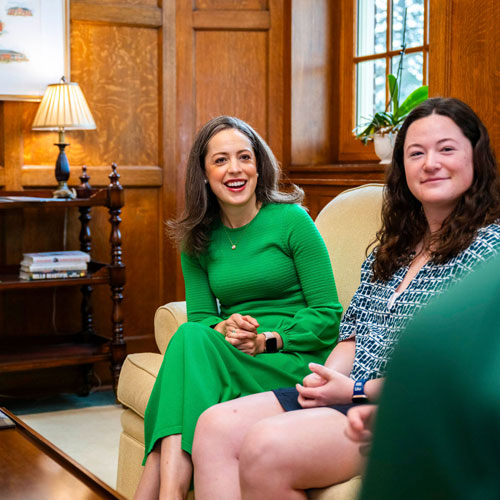
The idea to more closely align SEL and DEI work across divisions began last summer with Interim Head of Middle School Melinda Martin. Serving on multiple committees, Martin noticed that while many groups were doing strong, thoughtful work, those efforts were not always connected—or positioned in ways that maximized their impact on students.
“We have a lot of entities doing great work,” Martin says, “but are we putting them in the right place?”
Martin approached SEL Department Chair and psychologist Amy Cuddy, PhD, with the idea of using the summer months—one of the few times in the school year that allows for deeper, uninterrupted work—to step back and ask a fundamental question: What is our North Star? In other words, what are we ultimately trying to equip students with as they grow academically, socially and emotionally?
That question led to a summer project bringing together the SEL and DEI departments, including Director of Diversity, Equity, and Inclusion Amy Golden-Shepherd, and other faculty members who are deeply engaged in this work. The goal was not to reinvent existing programs, but to better connect them.
“We wanted it to be woven into what they were already doing and make it a seamless transition for people,” Golden-Shepherd says.
Lower School social justice themes, Middle School advisory structures, Upper School DEI assemblies and SELF classes (Social Emotional Learning Foundations, formerly wellness classes) were already addressing overlapping ideas. The challenge, and opportunity, was alignment.
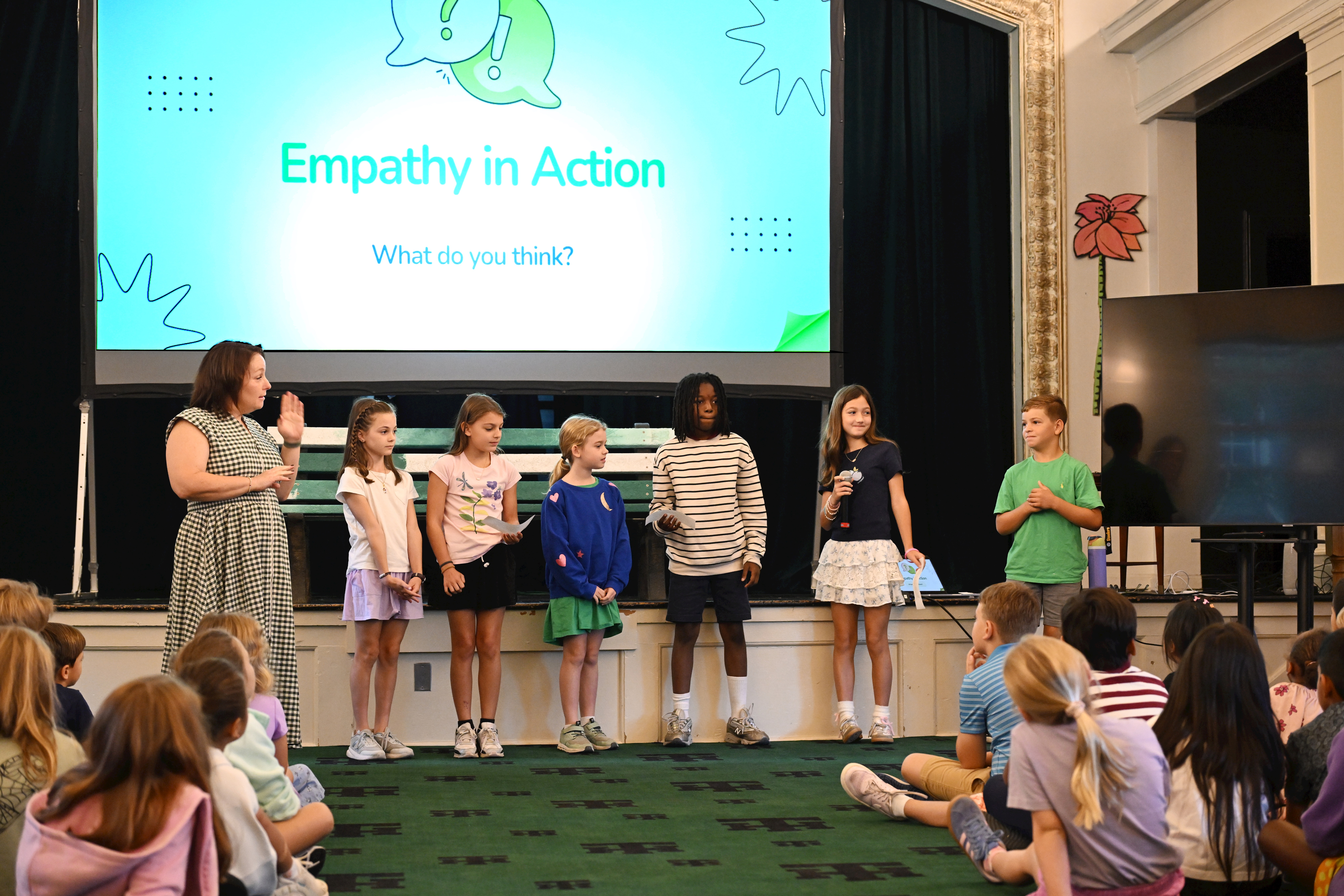
The result is a pilot-year initiative that dedicates one assembly each month, across all divisions, to shared SEL and DEI themes such as empathy, identity, perspective-taking and community. While the themes are consistent schoolwide, the content and delivery are developmentally tailored. A concept introduced through storytelling in the Lower School might be explored through guided discussion in the Middle School and expanded into more complex dialogue in the Upper School.
Following assemblies, students engage in breakout conversations in advisory or homeroom, often supported by brief, accessible resources developed by the SEL and DEI teams. Cuddy explains, “The intent was to create reasonable, but not overwhelming, tools.” The materials advance departmental goals while also making it easier for teachers to lead meaningful conversations.
Importantly, this work is grounded in relationships. The Wellness Center remains committed to supporting new students through check-ins and early meetings, recognizing that “breaking in” socially can be a challenging process. Faculty are also invited into the process, both through feedback and participation, ensuring that the adults guiding these conversations feel prepared and supported.
“This is about being proactive rather than reactive,” Cuddy says. “It all goes back to relationships.”
Golden-Shepherd echoed that sentiment, noting that DEI goals—such as developing cultural competency and understanding one’s own identity—are deeply connected to SEL skills. “This work really addresses that,” she says. “It’s also about recognizing how diverse our community is and asking whether everyone is experiencing Tower Hill the way we hope they are.”
As a pilot year, the initiative will continue to evolve. Summer debriefs, faculty input and expanded student voice—including more student-led assemblies—are all part of the plan. Engaging families may be a future step, equipping parents with shared language and understanding of what students are learning.
“It takes a team,” Golden-Shepherd says. “We’re not working in silos.”
SUPPORTING THE ADULTS WHO SUPPORT STUDENTS: THRIVE
Social emotional support does not stop with students. The THrive Team focuses on faculty and staff wellness, recognizing that those who give so much of themselves each day also need moments of care.
Led by Director of Physical Health and School Nurse Lexy Herbein, MSN, RN, THrive is a 10-member team representing different areas of the school. Their work ranges from small, everyday gestures to larger community-building initiatives—all designed to help faculty and staff feel appreciated and connected.
“People notice the small things,” Herbein says. “They really do make a difference.”
Those small things might include snacks during professional development days or a coffee bar during Opening Week—moments that signal appreciation and set a positive tone.
This year, THrive introduced a Faculty and Staff Media Day, inspired by the way student athletes are celebrated. “This is our season too,” Herbein explains. The event gave faculty and staff a chance to show their personalities, be a bit silly and be seen by families in a new way.
Larger initiatives, such as the Health and Wellness Fair or schoolwide fitness challenge, at the start of the year, help welcome new employees and spur good-natured rivalry and camaraderie. “It opens the year with joy,” Herbein says, with the goal of sustaining that feeling beyond the first few weeks. To continue with the fitness theme, the school offers weekly exercise classes for faculty and staff.
THrive also supports quieter moments of care. The Oasis Room in the Nurse’s Office offers a dedicated space to recharge, complete with a massage chair, weighted blankets, calming music and dim lighting. “When you just need a moment,” Herbein says, “it’s there.”
Ultimately, THrive’s philosophy mirrors the school’s work with students: wellness is relational. “People are talking, smiling and happy—and that’s wellness,” Herbein says. The team actively invites ideas, partnerships and new members, reinforcing that belonging is a shared responsibility.
As Martin succinctly puts it, “Collaboration is power.”
Across SEL, DEI and THrive, Tower Hill’s approach to belonging is intentional, evolving and deeply human—rooted in the belief that strong relationships, shared language and collective care create a community where everyone can thrive while being authentically themselves.









.jpg&command_2=resize&height_2=85 "Drew Pratt '23")