By Meg Grotti, Upper Grades Librarian and Director of Academic Research
What does it mean to be an engaged scholar at Tower Hill?
What does that look like, and what should a graduating Hiller know about how knowledge is constructed that can equip them in an increasingly AI-mediated world? How do we support a wondering disposition in our students and prepare Hillers with tools to investigate the things that make them curious, whether that inquiry is the feasibility of an entrepreneurial idea, the benefit of a certain medical plan, or what it is about a work of art that gives it emotional resonance? What tools for asking questions and conducting an investigation should be in our graduates’ toolkit?
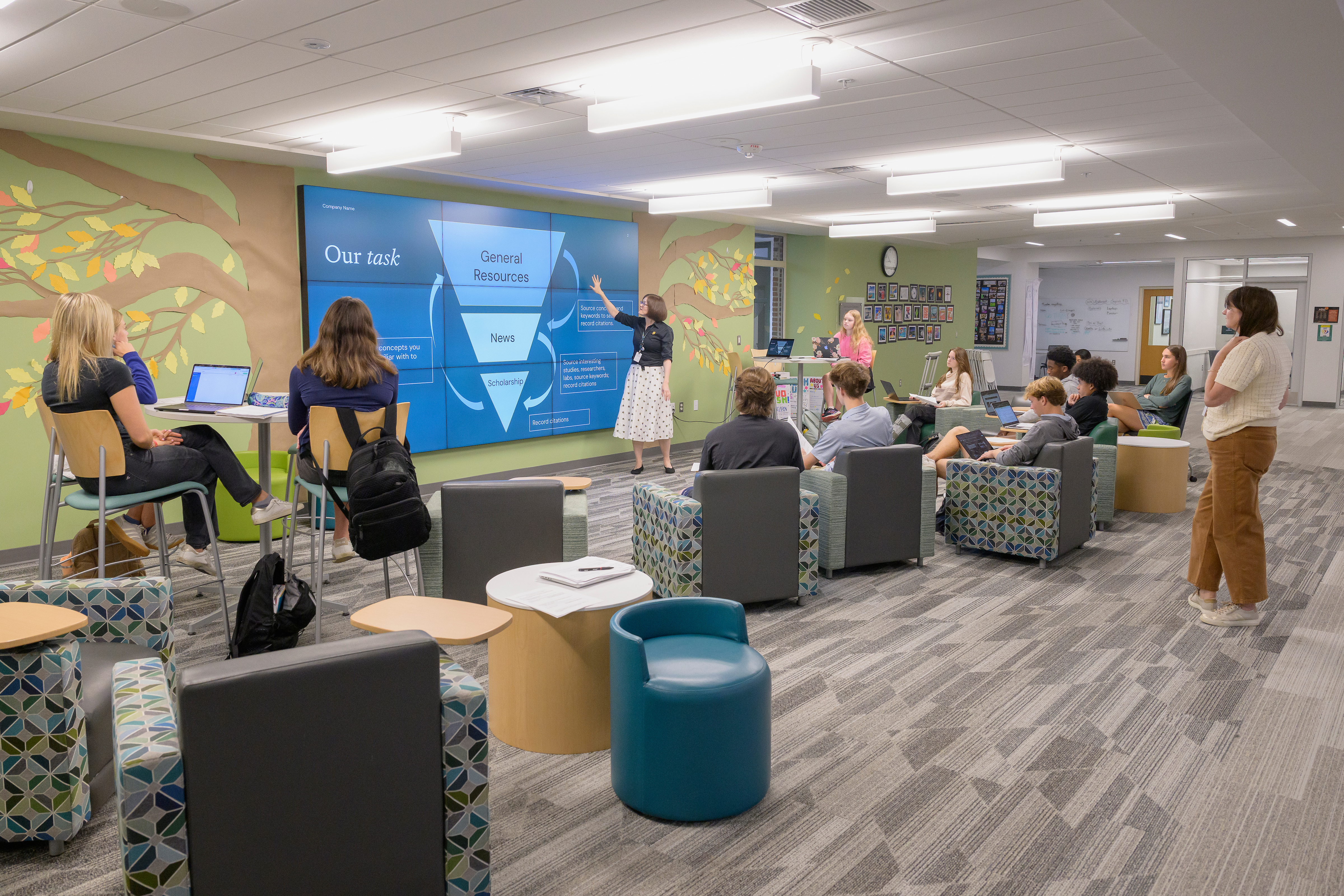
In my role as Upper Grades Librarian and Director of Academic Research, I am charged with shaping the collaborative effort to investigate questions like these in order to build Tower Hill’s research program. While much of my work in my first year has involved examining our curriculum and working directly to coach students who are searching for information, I wanted to go farther and provide students with an authentic research experience that would give students a meaningful learning opportunity while also helping me understand Hillers’ current ability to conceptualize a problem, suggest means of investigating that problem, analyze data and generate evidence-based solutions.
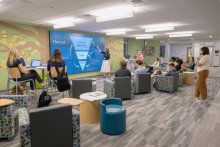
We are all naturally curious about the things we care about, so I decided to use our library space, the Neela Patel Center for Innovation - THE Hub, as the focus of our research. THE Hub is a beloved space for our students, but given our strategic goals, faculty want to make sure that it lives up to its promise as a space that meaningfully supports deep learning and study in addition to fostering student connection. What do we need to know about how students actually use the space in their daily lives to make smart decisions about changes? A group of 10 students on our Academic Board was ready to step up to the challenge of conducting an ethnographic study to find out.
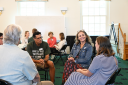
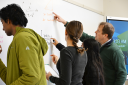
After discussing the disconnect between current and hoped-for use of the space, students on the Academic Board established a research question to guide the study: What social and academic activities happen in different areas of THE Hub, and how do those activities change throughout the day? As they considered how best to design a study that would provide answers to this question, several Tower Hill School faculty who have experience using ethnographic research methods joined the group as consultants. Students discussed ethnographic research with these faculty and asked our in-house experts questions that led to revisions to their study plan and informed their selection of research methodology. The Academic Board then worked with me to establish an observation protocol, which we tested and refined, exposing students to key research concepts such as reliability and validity. The students on the board are currently using the tool they designed to gather data about how students study, and what spaces they gravitate toward for different kinds of activities. This spring, the Academic Board will analyze the data and present their findings to inform future changes to our community’s central learning space.
While this project is just one example of the learning potential offered through personally relevant research opportunities for students, cultivating the thinking skills required to conduct this sort of original inquiry is more important than ever. With AI tools becoming ubiquitous and more effective at executing tasks, we are continually asking ourselves: “What are the critical thinking and discernment skills that machines are not able to do, and which we as people need to be doing? And what are the thinking skills that—even if generative AI is capable of simulating them—our students need to cultivate and practice while their brains are still developing?” By engaging with these questions, we ensure that our students are poised for success as they take on the mantle of leadership in an increasingly complex world.






.jpg&command_2=resize&height_2=85 "Drew Pratt '23")